Error Handling
All execution-level methods (transact(), transactRead(), execute(), run()) throw DatabaseException, which is unchecked. You never need throws declarations on your method signatures.
Sealed exception hierarchy
DatabaseException is a sealed class with three subtypes:
| Subtype | Carries | When |
|---|---|---|
DatabaseException.Postgres | PgError with 17 structured fields | PostgreSQL connections |
DatabaseException.SqlServer | SqlServerError with 7 structured fields | SQL Server connections |
DatabaseException.Jdbc | SQLException | All other databases |
All three share a sqlState() method on the base class, so you can handle errors generically or match on the specific subtype.
Pattern matching
Use Java 21 pattern matching to handle each database differently:
try {
    insertUser.on(user).transact(tx);
} catch (DatabaseException.Postgres pg) {
    if ("23505".equals(pg.sqlState())) {
        String constraint = pg.pgError().constraintName();
        // handle unique violation
    }
} catch (DatabaseException.SqlServer ss) {
    System.out.println("Error " + ss.sqlServerError().errorNumber());
} catch (DatabaseException.Jdbc e) {
    System.out.println("SQL state: " + e.sqlState());
}
SQL state handling
When you only care about the error category and not the database, catch the base class and switch on sqlState():
try {
    insertUser.on(user).transact(tx);
} catch (DatabaseException e) {
    switch (e.sqlState()) {
        case "23505" -> handleDuplicate();
        case "23503" -> handleForeignKey();
        default -> throw e;
    }
}
Common SQL state classes:
| Class | Meaning |
|---|---|
"23" | Integrity constraint violation |
"42" | Syntax error or access rule violation |
"08" | Connection exception |
"40" | Transaction rollback |
PostgreSQL errors
DatabaseException.Postgres carries a PgError record with all fields from the PostgreSQL ErrorResponse wire protocol message:
The required fields are severity, message, and sqlState. Nullable fields include detail, hint, position, where, schemaName, tableName, columnName, dataTypeName, and constraintName. Additional internal fields (internalPosition, internalQuery, file, line, routine) are available for PL/pgSQL debugging.
Formatted error messages
getMessage() produces multi-line formatted output. For a syntax error with a position field, the output includes a caret pointing to the error location:

For a unique constraint violation, detail and constraint fields are appended:
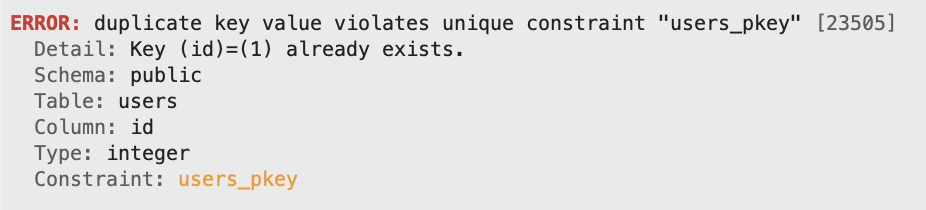
When the driver provides a hint, it's included along with the caret:

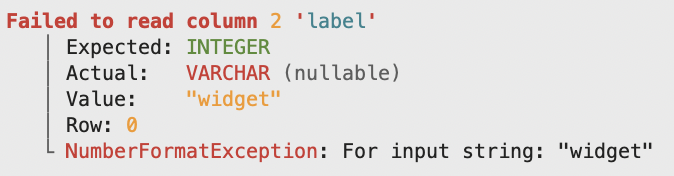
When a ResultSet value doesn't match the expected type at runtime, the error includes the column position, expected and actual types, the offending value, and the root cause:
SQL Server errors
DatabaseException.SqlServer carries a SqlServerError record with fields from the TDS ERROR token:
| Field | Type | Description |
|---|---|---|
message() | @Nullable String | Error message text |
errorNumber() | int | Vendor error number (e.g. 2627 for unique violation) |
errorSeverity() | int | Severity level (0-25) |
errorState() | int | Error state |
serverName() | @Nullable String | Server that raised the error |
procedureName() | @Nullable String | Stored procedure name, if applicable |
lineNumber() | long | Line number within the batch or procedure |
Where checked exceptions remain
SQLException is still used in implementation interfaces (SqlFunction, DbRead, DbWrite, ResultSetParser), where your code interacts with JDBC directly. The framework catches SQLException at the execution boundary and wraps it in the appropriate DatabaseException subtype.
Spring integration
Spring's @Transactional rolls back DatabaseException automatically since it is unchecked:
@Transactional
public void placeOrder(Order order) {
    insertOrder.on(order).transact(tx);
    updateInventory.on(order.itemId()).transact(tx);
}
See Spring Boot for full integration details.